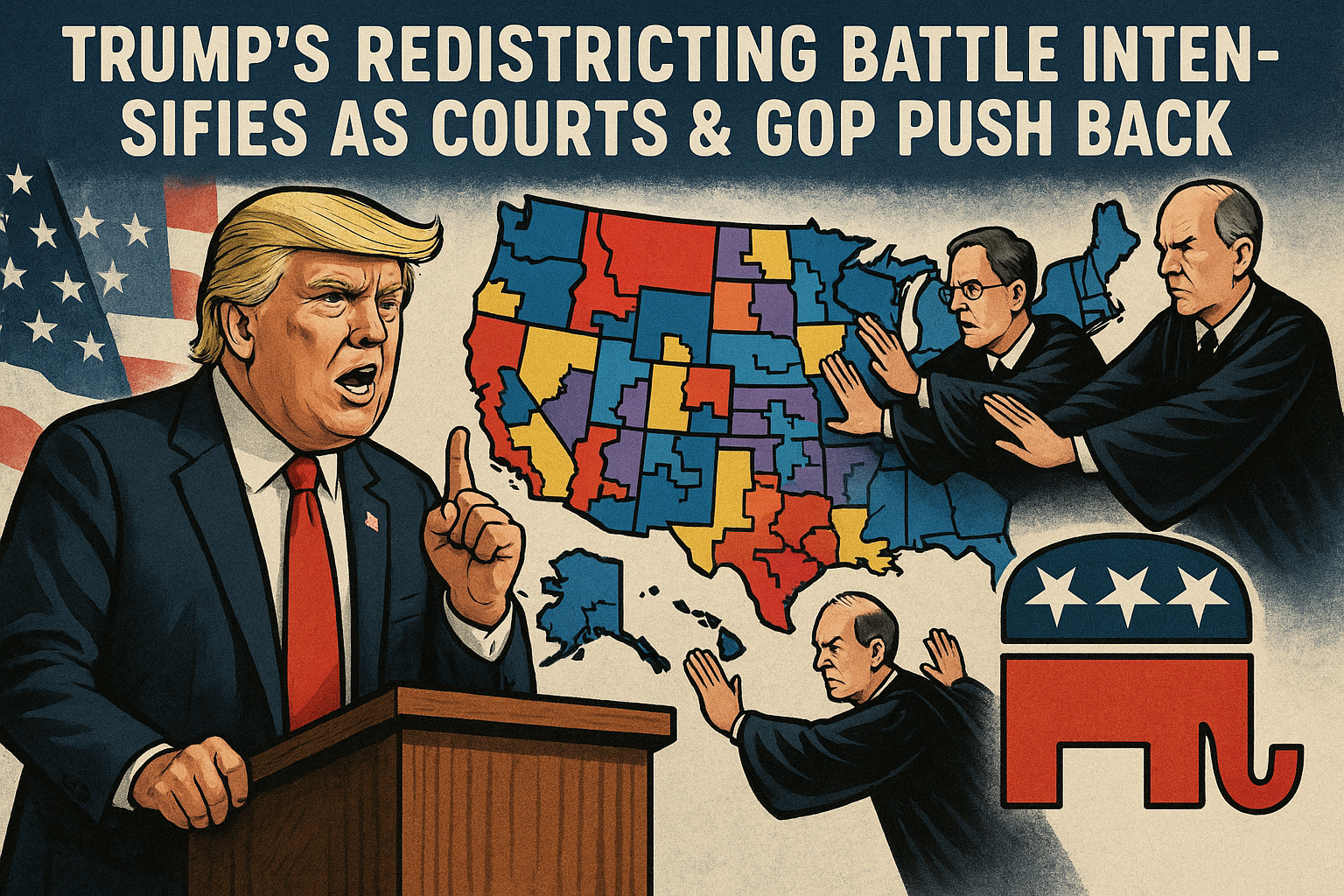
Donald Trump’s renewed push to force mid-cycle redistricting across several Republican-led states has ignited one of the most consequential political clashes heading into the 2026 midterms. What Trump initially framed as a strategic correction to “unfair” district maps has become a sprawling legal and intra-party battle, drawing objections not just from Democrats, but from judges, strategists, and Republican legislators themselves.
The former president’s strategy centers on redrawing congressional lines in Texas, Indiana, Kansas, and Missouri to strengthen GOP dominance in the House. But mid-cycle redistricting—outside the standard 10-year census cycle—faces major legal hurdles. Courts in Texas have already called similar efforts “unconstitutional alterations,” while GOP state leaders warn that forcing new maps now could create backlash, lawsuits, and voter confusion.
Political analysts say Trump’s redistricting push is also exposing cracks within the Republican Party. State lawmakers worry the effort could trigger judicial interventions that weaken GOP control long-term. Others warn that aggressive map-drawing may energize Democratic turnout.
With lawsuits looming and Republican hesitation growing, the redistricting fight is now less about maps and more about political influence. Trump’s pressure campaign underscores the tension between national ambition and state-level governance—and signals how volatile the 2026 election cycle could become.
Comments (0)